Fran Siegel: Arrábida
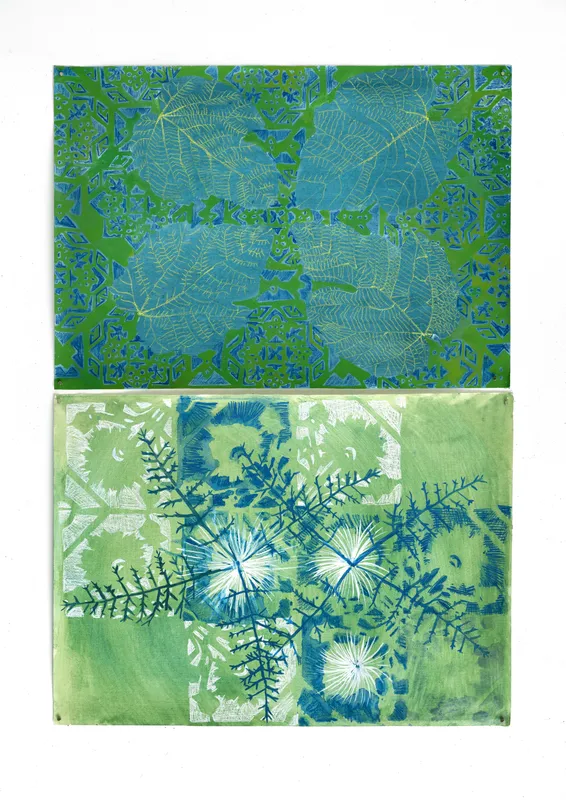
Wilding Cran Gallery is pleased to present Arrábida, a new series of works by Fran Siegel exploring the intersections of memory and place embedded within the botanical visual language of Portuguese azulejo tiles.
Developed during a Fulbright fellowship based in and around Lisbon, Ovar, and Arrábida Natural Park, Siegel’s research examines the botanical motifs of azulejos, the painted ceramic tiles that have shaped Portuguese architectural surfaces since the 16th century. Focusing on the botanical iconography of these painted ceramic tiles, the project examines how stylized vegetal forms both reflect and abstract local flora, while carrying histories shaped by trade, religion, and cycles of destruction and renewal. Shaped by principles of ornamentation and geometry, these tiles serve as vessels of cultural transmission and identity formation, foregrounding the relationship between living plant ecologies and built environments.
At the core of Arrábida is the concept of a fachada transparente—an azulejo aesthetic in which tile patterns extend perception beyond the physical façade, creating a sense of spatial permeability. Siegel activates this idea through layered processes of drawing, cyanotype, painting, shadow projection, translucency, and collage, constructing what she describes as a practice of visual cartography. Within Fig Thistle, 2025, layers of direct plant impressions and hand-drawn geometries pulse in blues and greens punctuated with white, allowing organic forms to bleed into and disrupt their geometric structures. This interplay foregrounds the historical relationship between botanical imagery and geometric order, alongside classificatory systems—scientific, decorative, and symbolic—that have shaped how the natural world is observed, represented, and claimed.
Across the exhibition, the series of multi-panel works unfolds as diptychs, triptychs, and six-part compositions, emphasizing fragmentation and recombination as methods of meaning-making, with each segment functioning both independently and as part of a larger system. Siegel’s process integrates extensive field documentation: walking and mapping Lisbon’s streets to record tile facades, cataloguing recurring patterns, studying restoration techniques alongside local artisans, and exploring botanical gardens as historic sites of imperial power, where scientific classification developed in tandem with colonial expansion and the circulation of plant life across continents. In Siegel’s modular installation Jardim Ajuda, 2026, named for an imperial botanical garden, individual tile elements function as receivers, while a draped cyanotype on fabric traces the artist’s pathways through the city, generating a cartographic study of cultural motifs embedded within the urban landscape.
Through drawing as a method of anthropological study, Arrábida positions azulejo tiles as sites of inquiry, revealing the dense interrelations between cultural exchange, geographic identity, and imperial taxonomies of the natural world—systems through which identities are constructed, contested, and transmitted across time and territory. In Siegel’s work, the tile becomes an allegorical device: a fig leaf, a thistle, a sprig of holly come to reflect a broader matrix of spatialized identity, ancestral memory, and exchange.
Fran Siegel's exhibition Arrábida coincides with the May 8, 2026, opening of her commissioned permanent public installation at the Wilshire/La Brea Metro station in Los Angeles. In a continued exploration of the iconographies and architectures of urban identity, the tiled work is part of the D Line Subway Extension Project, a site-specific initiative spanning seven new Metro stations.
Fran Siegel has developed and exhibited work throughout Europe and South America. As a Fulbright fellow in Brazil, she conducted research for Lineage Through Landscape which was included in Getty's city-wide initiative PST- Los Angeles/Latin America with her 2017 solo exhibition at The UCLA Fowler Museum. In 2024 her project In Flux was included in Getty's PST- Art and Science Collide. In 2025 she was awarded a second Fulbright to Portugal. Residency fellowships inform her location-based practice and include: The Bogliasco Foundation and Siena Art Institute in Italy; La Napôule and Camargo/Bau Foundation in France; CCA Andrax, Spain; and Instituto Sacatar, Bahia, Brazil. Siegel represented the United States in the IX International Biennial of Cuenca, Ecuador and Art in Embassies commissioned a permanent work for the U.S. consulate in Guayaquil, Ecuador.
Siegel received grants from the California Community Foundation, Los Angeles Individual Artist C.O.L.A., Center for Cultural Innovation, and the OC Contemporary Collectors Grant. She earned her M.F.A. from Yale University School of Art, and B.F.A. from Tyler School of Art. Siegel's works are in public collections at Los Angeles County Museum of Art, Los Angeles, CA; The Museum of Contemporary Art, Los Angeles, CA; Art, Design & Architecture Museum, Santa Barbara, CA; Long Beach Museum of Art, Long Beach, CA; Yale University Art Gallery, New Haven, CT, and The Morgan Library Museum, New York, NY.
